What was meant to be a quiet moment of comfort for widowed mother of two Erika Kirk became a viral talking point overnight. A brief embrace with Vice President JD Vance at a public event — and the way her hand moved to the back of his head — set off a wave of scrutiny, speculation, and criticism across social media.
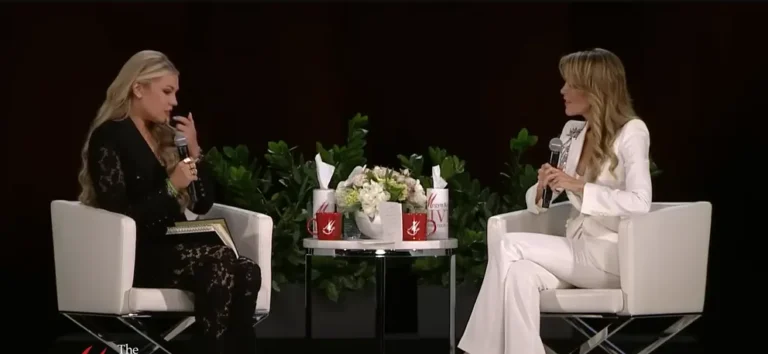
Now, weeks after that hug, Erika Kirk is sharing her side of the story. Speaking at a sold-out “Megyn Kelly Live” event in Phoenix, she explained what really happened during that emotional encounter with JD Vance and how it felt to see a moment of raw grief turned into a public debate.
A Grieving Widow Suddenly Under the Microscope
Erika is the widow of conservative commentator and activist Charlie Kirk, whose life was cut short in a tragic attack at Utah Valley University on September 10. Only days later, on September 21, she stood at a memorial service honoring her husband, trying to hold herself together in front of cameras and supporters.
By late October, her life had shifted again. Erika traveled to the University of Mississippi, where she was formally introduced as the new CEO of Turning Point USA, the conservative organization her husband helped build. It was there, on October 29, that she shared the stage with Vice President JD Vance — and where the now-famous hug took place.
The embrace, seen by many as a simple moment of consolation between long-time allies, would later be slowed down, zoomed in on, and dissected frame by frame by people who had never met her.
The Back-of-the-Head Touch that Went Viral
At “Megyn Kelly Live” on November 22 in Phoenix, Erika finally addressed the hug directly. She told the audience that the gesture so many people focused on — her hand resting briefly on the back of JD’s head — was not romantic, calculated, or unusual for her.
“Anyone I’ve hugged and touched on the back of the head,” she explained, is someone she’s blessing in that moment. It’s part of how she expresses care. “My love language is touch,” she said with a small smile, adding that she’s always been the sort of person who will offer a hug to anyone who needs one.
For Erika, that hug was simply an instinctive act of comfort. The crowd had just watched a deeply emotional tribute to her late husband. She and JD walked toward each other on stage, and the weight of the moment hit her all at once. As she remembers it, he told her quietly, “I’m so proud of you,” and she responded, “God bless you,” while placing her hand at the back of his head.
To her, it was a familiar, faith-filled gesture. To the internet, it became something else entirely.
“Whoever Is Hating on a Hug Needs a Hug Themselves”
Erika told the Phoenix audience that the people closest to her understand her affectionate nature and how she uses touch to comfort others in distress. She emphasized that she hugs like that in private just as readily as she does in public.
She also offered a gentle rebuke to those who rushed to judge her: people who spend their time attacking a hug, she suggested, might be revealing more about their own unhappiness than about her intentions. In her words, anyone “hating on a hug” may well be in need of one.
For older Americans who have watched public life grow harsher and more polarized, her comment may resonate: a reminder that, sometimes, a moment of tenderness really is just that.
The Private Pain Behind the Public Moment
Beyond the hug itself, Erika used her appearance to share more of the grief and longing she’s been carrying since losing her husband. At 37, she is raising their two young children — a daughter and a son — while navigating both personal mourning and public expectations.
She revealed that she had been praying to be pregnant at the time of Charlie’s death. The couple had hoped for a large family and wanted four children. In the middle of the chaos and heartbreak, the thought that she might be carrying another baby felt like a tiny thread of hope — “the ultimate blessing,” as she put it, in the middle of a catastrophe.
That wasn’t the case, but the longing itself helps explain the emotional intensity people saw in her at recent events. When Erika walked onto that stage with JD Vance, she wasn’t just a new CEO. She was a young widow trying to steady herself while publicly assuming her husband’s role, in front of a nation already watching her closely.
A Ceremony Meant to Honor Charlie Kirk
The October 29 event at the University of Mississippi was meant to showcase continuity after loss. Erika spoke openly about how carefully she’d considered inviting JD Vance to speak that day. It was, she admitted, an “emotional, emotional day,” and she wanted to be sure she was choosing the right person for such a moment.
She said she prayed about it, and ultimately felt she could “hear” Charlie in her heart, encouraging her to keep moving forward, to “reclaim that territory,” and to trust that love and faith would carry her through.
When she introduced the vice president, Erika noted that no one could ever replace her husband, yet she saw certain similarities between Charlie and JD — in values, in outlook, and in the way they approach public life. That sense of familiarity is part of why she felt so grateful to have JD there with her onstage.
As JD walked out, the two shared a lengthy, emotional hug. From the audience, it appeared to be simply an embrace between friends in the middle of a hard day. Online, however, it quickly turned into something else.
A Hug Turned Into a Flashpoint
Once clips of the embrace began circulating, many viewers zeroed in on details: Erika’s hand moving to the back of JD’s head, JD’s own hands on her waist, the length of the hug. Short video clips, divorced from the full event and stripped of sound, fueled a rush of speculation.
Some online commenters insisted the interaction seemed “too intimate” for a married man and a widow who is not his spouse. Others said they would never hug a friend’s husband in that way. A few even suggested that the gesture looked like something reserved for people in love, rather than for colleagues or friends sharing a moment of grief.
From there, the conversation escalated. People began wondering aloud about the impact on JD’s marriage to his wife, Usha. Strangers speculated about possible marital trouble, with some predicting future divorce or even guessing at a future relationship between Erika and JD — all based on a few seconds of video and where one hand happened to land in the middle of an embrace.
For anyone who grew up in a world where private moments tended to stay private, watching this kind of public dissection can feel especially jarring.
A Lip Reader Weighs In on What Was Really Said
In the midst of the debate, a professional lip reader, Nicola Hickling, was asked to review the footage. Her conclusion was not salacious or dramatic — instead, it echoed Erika’s own account of a raw, emotional exchange.
According to Nicola, just before taking the stage, Erika quietly told an assistant backstage that she didn’t feel ready, that she needed a moment. By the time she introduced JD, she had gathered herself, but the strain showed.
During the hug itself, the lip reader believes JD told her he was proud of her. Erika’s response, as Nicola interpreted it, was a simple, painful truth: “It’s not going to bring him back.”
In other words, what viewers were seeing was not flirtation or secret romance. It was a widow acknowledging, with heartbreaking honesty, that even praise, support, and new responsibilities can’t undo the loss she has suffered.
Nicola emphasized that the embrace looked like what many people have experienced in their own lives: two human beings clinging to each other for a moment in the midst of enormous pain, not an exchange meant to spark scandal.
From Viral Hug to Courtroom Focus
While much of the media conversation has centered on the hug with JD Vance, Erika herself has tried to keep public attention on something she considers far more important: the upcoming trial related to her husband’s killing.
In a separate interview, she pointed out that cameras have followed her, zooming in on every smile and every tear since Charlie’s death. If her every move can be analyzed in public, she argued, then the same transparency should apply inside the courtroom. She believes the public deserves to see the legal process unfold, and she has called for media access to the proceedings.
Her comments highlight a tension many public figures face, especially in times of tragedy: their pain is broadcast widely, yet they often have little control over which parts of their story are amplified.
Online Opinions and the Cost of Speculation
Even after Erika’s explanations — and the lip reader’s interpretation — social media remained sharply divided. Some people felt her hug with JD Vance crossed a line. Others defended her, saying that grief sometimes makes people cling to the nearest shoulder, and that judging a devastated widow’s body language from a distance is neither fair nor kind.
Speculation about the vice president’s marriage to Usha also continued, despite there being no public evidence of trouble between them. Comments predicting divorce or romantic drama between Erika and JD piled up, often from people who know neither family personally.
For older adults who have watched public figures navigate tragedy in quieter times, this kind of instant, global reaction can seem not only intrusive, but deeply uncharitable. A moment that, in another era, might have passed with a sympathetic nod is now replayed, slowed, and argued over by strangers.
A Human Moment in a Harsh Digital Age
Inside the Megyn Kelly event in Phoenix, away from the online noise, Erika’s message was simple: she is a woman who lost her husband, a mother raising two young children, and a person whose natural response to pain is to reach out and touch, bless, and hold the people around her.
She asked the audience to see the hug with JD Vance for what it was to her — not a political signal or a romantic overture, but a vulnerable, faith-grounded gesture in a moment of overwhelming emotion.
Whether or not everyone agrees with how she expressed herself, there’s a lesson tucked inside her story for anyone watching from afar: a few seconds of video rarely capture the whole truth. Behind every viral clip is a human being, living through something far more complicated than a headline or hashtag can express.
And in a world where so much feels divided, perhaps it’s worth remembering that sometimes a hug really is just a hug — especially when it comes from someone whose heart is still healing.