The Ardennes Forest — December 16, 1944
It began with a sound the men of the 106th Infantry would never forget.
Thunder.
Except it wasn’t thunder.
The ground trembled as 1,600 German artillery guns opened fire in unison across an 80-mile front. The Ardennes, peaceful only hours before, exploded into chaos. Snow blasted from the trees like smoke. The sky turned gray with the dust of ruptured earth.
Inside a foxhole near St. Vith, Private Andy Harper clutched his helmet as shells landed like falling planets.
“Lie still!” his sergeant yelled.
“It feels like the end of the damn world!” Andy shouted back.
The German offensive had begun.
The Battle of the Bulge.
Hitler’s last gamble.
The operation meant to split the Allied armies in two.
And it was working.
Supreme Headquarters — December 19
General Dwight D. Eisenhower stood over a huge battlefield map, the red arrows of the German advance pushing deep into Allied lines. Officers crowded around him, faces pale, breath tight. The atmosphere was heavy with dread.
The Ardennes was supposed to be quiet — a place for exhausted divisions to rest. Instead, tens of thousands were being swallowed by the fast-moving German spearheads.
Eisenhower tapped the map with the back of his pencil.
“If they reach Antwerp, the entire Western Front collapses.”
No one spoke.
Finally, Eisenhower turned toward the man standing casually at the back of the room, hands behind his back, jaw clenched like he was holding back impatience.
Lt. General George S. Patton.
His presence was electric — as if someone had plugged the room into a generator.
Eisenhower asked the question everyone feared:
“George… how long will it take you to disengage your army, turn north, and counterattack?”
Patton didn’t even blink.
“Forty-eight hours, sir.”
Laughter — nervous, disbelieving — broke out from the other generals.
Major General Beetle Smith shook his head.
“Impossible. Third Army’s facing east. Your supply lines—”
Patton cut him off.
“I’ve already issued three contingency plans to my corps commanders. They just don’t know which one they’re executing yet.”
Eisenhower lifted a brow.
“You planned this before I asked?”
“Sir,” Patton said, stepping forward, “the Germans didn’t pick this moment because they’re clever. They picked it because they think we’re slow. They think we react like bureaucrats.”
He leaned over the map.
“I intend to prove them wrong.”
The room fell silent.
Eisenhower studied him. He knew Patton’s faults — his temper, his ego, his unpredictability. But he also knew this: Patton was the only commander in Europe who could move an army like it was a living creature.
“Very well,” Eisenhower said quietly.
“Do it.”
Patton saluted, spun on his heel, and strode out.
One of the officers murmured,
“It can’t be done.”
But Eisenhower, watching Patton disappear down the hallway, said under his breath:
“If anyone can… it’s him.”
Third Army Headquarters — December 19, 1944 — 1:14 p.m.
When Patton burst into the tactical room, officers snapped to attention before he even yelled.
He didn’t sit. He didn’t warm up. He went straight into the storm.
“Gentlemen,” he barked, “we are moving. Not tomorrow. Not tonight. Now.”
Colonels and majors exchanged stunned looks.
They had expected new instructions — not a full inversion of the entire Third Army.
But Patton didn’t slow for disbelief.
He pointed at a giant map pinned to the wall.
“Twelfth Army Group wants us to turn ninety degrees north. Through blizzards. Through ice. Through traffic jams. Through roads a damn mule wouldn’t walk on.”
He slammed a fist onto the table.
“We’re doing it in forty-eight hours.”
A murmur spread through the room; some faces drained of color.
Major General Hugh Gaffey cleared his throat.
“Sir… with respect… moving the III Corps that fast means—”
“Means miracles,” Patton snapped. “Which is why I expect you all to become saints in the next two days.”
Another officer, Colonel Harkins, spoke carefully:
“Sir… the men are exhausted. They’ve been advancing nonstop for weeks. They aren’t equipped for Arctic temperatures.”
Patton’s gaze sharpened.
“Neither are the Germans. But guess what?”
He leaned in.
“We are Americans. We improvise. We endure. We win.”
He jabbed a finger toward the north.
“The 101st Airborne is surrounded at Bastogne. If we don’t reach them, they’re dead. And if they’re dead, this war gets a hell of a lot longer.”
Silence.
Every man in that room knew Patton wasn’t exaggerating.
Patton’s voice dropped to something almost reverent.
“We’re going to save them. All of them.”
A young captain swallowed hard. “Sir… then what’s the plan?”
Patton grinned — wolfish, electric.
“Move. Everything. Now.”
The Logistical Nightmare Begins
Over the next six hours, the Third Army transformed from a machine of momentum into one of impossible mobility.
Convoys of trucks screeched from staging areas.
Artillery battalions wheeled around like choreographed dancers.
Fuel units scrambled to reroute tank resupplies on icy roads.
Radio operators barked orders so fast their voices cracked:
“Turn north at once—priority red!”
“All supply lines rerouted—expect bottlenecks!”
“Snow conditions degrading—chains required!”
In mess halls across eastern France, soldiers dropped spoons mid-bite as runners burst in shouting:
“Orders from Patton! Pack your gear! We move in one hour!”
Men who hadn’t slept in thirty-six hours scrambled to their feet.
Staff Sergeant Bill Timmons slung his rifle and muttered to the private next to him:
“Jesus Christ… what’s he want now?”
Private Leon Jacobs answered:
“To prove he’s Patton.”
Snow thickened.
Winds picked up.
Night fell like steel.
December 20 — 2:07 a.m. — Somewhere near Metz
A column of Sherman tanks crawled along a narrow road barely wide enough for one vehicle.
Inside the second tank, Lieutenant Adam Brewer held his hands near a small heater barely warmer than breath.
“How long we goin’ north?” asked Corporal Dent.
“Until Patton says stop.”
“You think he’s crazy enough to pull this off?”
Brewer hesitated — then shook his head.
“No. He’s crazier. He thinks we can pull it off.”
Behind them, troops marched through snow sometimes knee-deep. Wind cut through overcoats. Frost formed on eyebrows, eyelashes, boot buckles.
No one complained.
War had taught them a truth:
When Patton moved, it meant something big was coming.
Patton’s Jeep — Racing the Blizzard
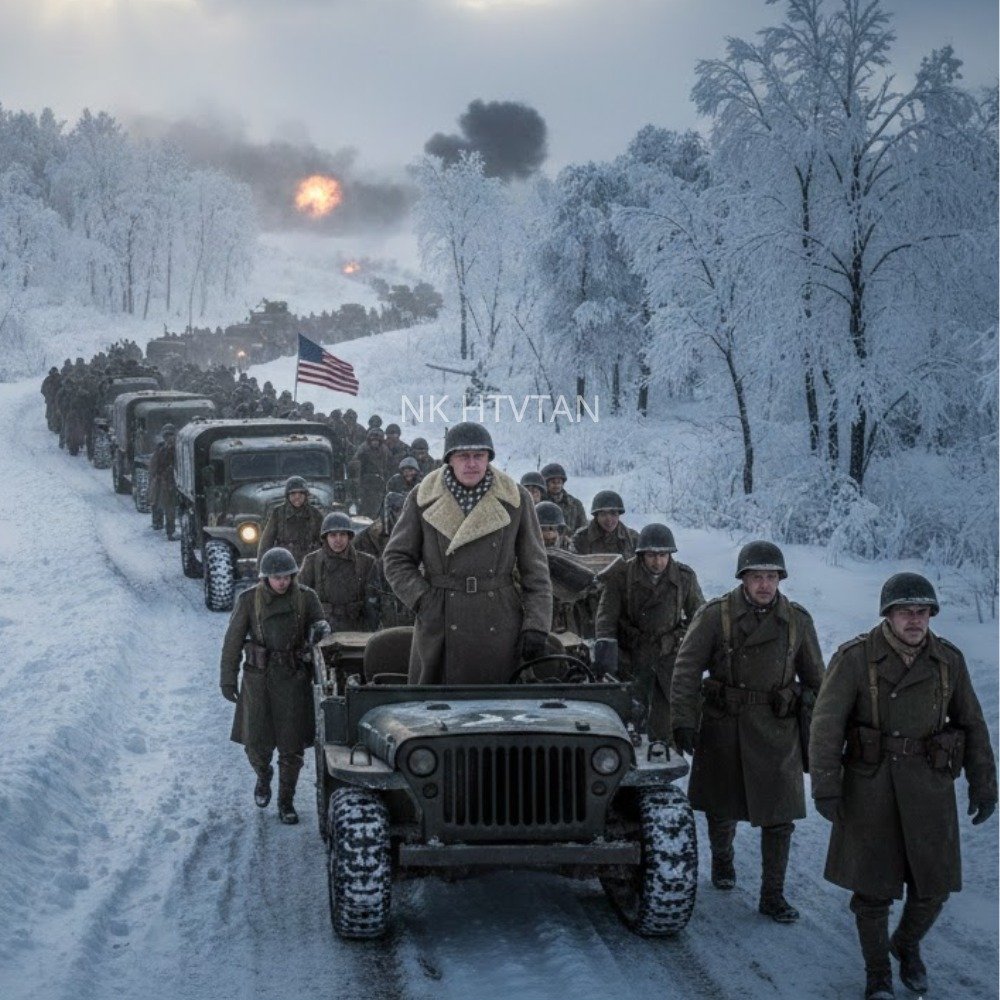
Patton rode not in a heated staff car but in an open jeep — snow lashing his face, scarf whipping behind him like a general’s banner.
He stood up in the seat, gripping the windshield frame, shouting at passing units:
“Keep moving, boys!”
“Third Army’s going to relieve Bastogne!”
“Faster! The Krauts sure as hell won’t wait!”
Soldiers cheered back through chattering teeth.
His driver, PFC Bob Ferrell, yelled over the wind:
“Sir! You’ll freeze to death if you keep standing like that!”
Patton didn’t sit.
“Ferrell, I didn’t come this far in life to save my skin! Keep going!”
The jeep swerved through snowdrifts as Patton scanned the endless convoys — so many that headlights turned the night white with motion.
The Prayer Everyone Still Talks About
By dawn, the blizzard had thickened so much that air support was impossible. Patton knew his tanks couldn’t break through without the skies clearing.
He stormed into the VIII Corps chaplain’s tent, scattering snow from his coat.
“Father O’Neill!”
The chaplain leapt to attention.
“Yes, General?”
“I want you to write a prayer.”
“A… prayer, sir?”
“Yes, a prayer!” Patton snapped. “For good weather.”
O’Neill blinked. “You… want me to pray for the weather?”
“I want you to pray for a goddamn miracle.”
The chaplain hesitated only a second.
“What should it say?”
Patton leaned in, eyes wild with urgency.
“Ask for the skies to clear so that we may kill our enemy. Ask for weather that lets us finish this job.”
“And you want your entire army to recite it, sir?”
“No.”
Patton cracked a grin.
“I want them to believe it.”
Within hours, 250,000 prayer cards were printed and distributed across Third Army.
Men recited it in foxholes.
Tank crews muttered it over engines.
Officers whispered it like a secret pact with fate.
Even the nonbelievers spoke it — because if Patton believed, maybe God did too.
Miracle Over the Ardennes — December 22
The next morning, the clouds parted.
Widely. Abruptly. Impossible to explain.
Sunlight glinted off the snow like polished armor.
American fighter planes roared into the sky.
In the operations tent, Patton’s chief of staff whispered:
“My God. That prayer… it worked.”
Patton lit a cigar.
“God favors the side with the best commander.”
He blew smoke toward the ceiling.
“And the best plan.”
The skies were clear.
The roads were packed with Third Army convoys.
And Bastogne still held.
The race to the 101st Airborne was on.
December 22, 1944 — Bastogne, Belgium
101st Airborne Headquarters — the Siege Tightens
Lieutenant Colonel Harry Kinnard stood inside a dim cellar lit by a single lantern, listening to the pounding of German artillery outside. The earth trembled with each hit — like a drumbeat announcing the inevitable.
His men were tired. Frozen. Hungry.
Medical supplies had run out. Ammunition was rationed.
Blood froze before it hit the ground.
Tourniquets were tightened with bare teeth.
Medics prayed more than they stitched.
And still — the 101st Airborne held.
General McAuliffe, the acting commander, reviewed a German message demanding surrender.
“They want to negotiate,” Kinnard said.
McAuliffe coughed — exhaustion nearly doubling him over — and muttered the word that would enter history like a gunshot:
“NUTS.”
The reply went back, short and defiant.
German commanders were baffled.
American paratroopers?
Laughing, while surrounded?
Because despite the cold, the hunger, the death rotating through the lines like a carousel — they believed Patton was coming.
Somewhere in the frozen dark…
American engines rumbled.
Meanwhile — Patton’s Third Army
December 23 — 4:30 a.m. — South of Luxembourg
The 4th Armored Division, led by the relentless Major General John S. Wood, had been pushing through blizzards and minefields for days.
Now the skies were clear, revealing an army stretched like a living chain across snow.
Sherman tank engines roared.
Halftracks jolted over icy roads.
Infantrymen marched past mile markers crusted in frost.
Inside one tank, Private Leon Jacobs breathed into his hands.
“How close are we?” he asked.
Lieutenant Adam Brewer checked the map under a flickering lamp.
“Forty miles.”
Jacobs groaned. “Feels like four hundred.”
Brewer laughed darkly. “You know what Patton said?”
Jacobs rolled his eyes. “Don’t tell me.”
“He said… ‘Thirty miles in two days is impossible — so we’ll do it in one.’”
Jacobs cursed into his scarf.
“And we followed this man voluntarily?”
December 23 — Patton’s Command Jeep
Snow crackled under tires as Patton’s jeep carved through the night.
He stood again — refusing to sit — gripping the windshield frame with a bare hand, knuckles white against the cold.
Troops cheered when they recognized him.
“Goddamn miracle worker!” someone yelled.
Patton shouted back:
“I don’t work miracles — I make them irrelevant!”
His scarf snapped in the wind like a banner.
His pearl-handled pistols glinted under moonlight.
A colonel riding behind him muttered:
“He’s insane.”
Another officer replied:
“Yes. But he’s our kind of insane.”
Christmas Eve — The German Trap Tightens
Inside Bastogne, conditions slipped from desperate to catastrophic.
The wounded lay shoulder-to-shoulder on freezing stone floors.
Cries for morphine went unanswered — there was none left.
Blood stained snow crimson around aid stations.
Still, morale held.
Because at night, when artillery paused and silence settled, paratroopers leaned close and whispered one phrase:
“Patton’s coming.”
Outside the lines, German armor prepared the finishing blow.
If Patton failed…
Bastogne would fall.
And with it — the entire Western Front could collapse.
The stakes?
Nothing less than the war’s outcome.
December 24 — 11:50 p.m. — Near Chaumont
Patton stood over a massive paper map anchored by coffee mugs and grenades. Officers huddled around, breath fogging the air.
Roads were clogged.
Fuel was running low.
German resistance had increased dramatically.
Gaffey spoke first.
“Sir, the Krauts are expecting us—”
Patton cut him off.
“Of course they are!”
He slammed his fist on the table.
“But they sure as hell aren’t expecting us tonight.”
A captain frowned. “Sir, it’s Christmas Eve.”
Patton stared him down.
“Then let’s give Bastogne a present.”
He looked at his staff.
“Tomorrow, December 25th, Third Army breaks the German ring.
This is not a request.”
One by one, exhausted, frostbitten officers straightened.
They believed.
Christmas Morning — 1944 — The Breakthrough Begins
8:45 a.m. — The 4th Armored Division Attacks
Fog rolled over snowy fields as American armor advanced.
Shermans fanned out across the white expanse, engines growling like beasts awakened.
Lieutenant Brewer yelled over the radio:
“Keep formation! Watch those treelines! Mines likely!”
German machine guns sliced through the fog, sending tracers sparking across tank hulls.
Infantrymen dove for cover, boots slipping on ice.
A sergeant hissed:
“Feels like the whole damn Reich is shooting at us!”
But they kept moving.
Every mile north meant one mile closer to Bastogne.
Every step they took was purchased with blood.
Inside Bastogne — Paratroopers Hold the Line
In a foxhole ringed with frozen roots, Private Sam Wilburn ate a Christmas “dinner” of cold beans and snow.
He heard distant artillery.
“Sounds different,” he muttered.
“Maybe the Krauts change their tune for Christmas?” joked Corporal Henry Boyd.
Wilburn shook his head slowly.
“No… that’s tank fire.
American tank fire.”
Boyd went still.
“Patton?”
Wilburn grinned weakly.
“Patton.”
Around them, paratroopers lifted their heads despite the cold.
They could feel it — like warmth rising from beneath the earth.
Relief was coming.
December 26, 1944 — 4:50 p.m. — The First Sherman Arrives
The battle reached its crescendo.
The 4th Armored Division slammed against German lines defending Bastogne.
Tanks erupted in fire.
Anti-tank guns hammered the snow.
Infantry crawled through freezing mud.
Lieutenant Brewer’s tank, battered but alive, pushed forward.
“Just one more village!” Brewer shouted.
The radio crackled:
“Lancaster Dog Two, Bastogne is less than two miles!”
Brewer slammed his fist into the side of the turret.
“Then let’s finish this!”
Shermans burst into the outskirts of Bastogne.
German troops retreated in shock — they had believed Patton couldn’t possibly arrive in time.
But American armor kept rolling.
Snowflakes hissed on hot engines.
And then—
Up ahead, a group of ragged American paratroopers emerged from the smoke.
One of them — Sergeant Ernest Premetz — stared in disbelief, then yelled:
“Goddamn! It’s the 4th Armored!”
Infantry cheered with cracked voices.
Tears froze on cheeks.
Paratroopers pounded on tank hulls with gloved fists.
They were saved.
That Evening — Patton Gets the Report
A junior officer rushed into Patton’s headquarters tent.
“Sir! The siege is broken! Bastogne is relieved!”
Patton exhaled once — deeply.
A rare, quiet moment.
Then he said:
“Good. Now let’s drive the bastards back to Berlin.”
THE COST OF VICTORY
December 25, 1944 — Christmas in Hell
While American families back home carved turkeys and opened presents, the men of the 101st Airborne spent Christmas morning crouched in frozen foxholes, eating cold rations and firing at German artillery positions that hammered Bastogne like a drum of iron.
Snowflakes drifted through trees blackened by shellfire. Each explosion showered the men with dirt and pine needles. They fought frostbite, hunger, and exhaustion as fiercely as they fought the enemy.
Private Frank Horvath tore open a chocolate bar — stiff as a brick — and broke it with a combat knife to share with his friend.
“Merry damn Christmas,” he muttered.
His friend managed a grim smile.
“Be merry when Patton gets here.”
Horvath looked at the sky — gray, heavy, filled with the constant rumble of distant artillery.
“If Patton doesn’t get here soon,” he said quietly, “there won’t be anything left of us to save.”
The German Ultimatum
That morning, German officers approached Bastogne with a white flag and a message.
A formal demand:
Surrender or be annihilated.
General Anthony McAuliffe, acting commander of the 101st, read the letter, raised his eyebrows, and chuckled.
Then he scribbled his legendary reply:
“NUTS.”
When the Germans asked what the message meant, the American messenger grinned.
“It means you can go to hell.”
Inside the shattered town, the men repeated the phrase like gospel.
“NUTS!”
“To hell with ’em!”
“We ain’t giving up a damn thing!”
Courage. Defiance. A middle finger raised at impossible odds.
But courage alone wouldn’t stop panzers.
They needed Patton.
Fourth Armored Division — Racing Toward the Bulge
On icy roads south of Bastogne, the 4th Armored Division fought through villages turned to rubble, each one defended by German tanks with armor like steel monsters rising from the snow.
Lieutenant Colonel Creighton Abrams — yes, that Abrams — led the assault from the front, riding atop his Sherman tank with snow crusting his eyebrows.
He squinted at a distant crossroads.
“Clear that intersection,” he ordered. “That’s the last choke point before we hit Bastogne!”
His men surged forward.
Sherman tanks fired shells that lit up the night like brief molten suns.
German artillery cracked back with terrifying precision.
Snow mixed with smoke.
Smoke mixed with screams.
And still Patton’s men pushed on.
Patton Refuses to Stop
At Third Army Headquarters, officers begged Patton to slow down, to regroup, to let units rest.
He didn’t even look up from his maps.
“The men in Bastogne aren’t resting,” he growled.
“But sir—”
“NO ‘but’! We reach them tomorrow.”
He stabbed a finger at the map so hard it tore through the paper.