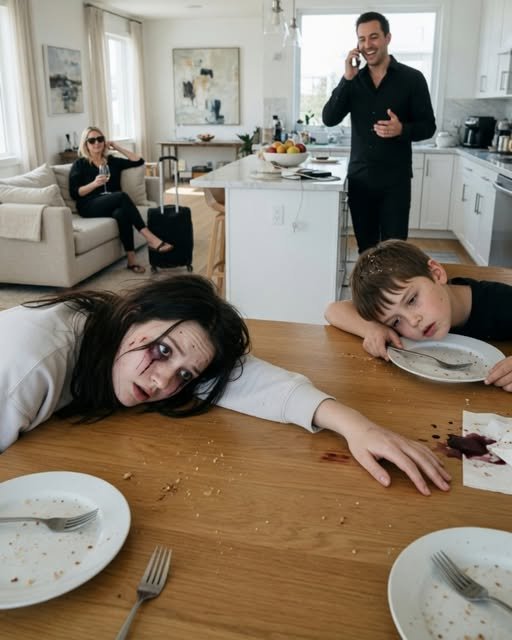
The night I understood that my husband had not only stopped loving me, but was willing to erase our son with me, the house smelled of a hot dinner and a lie that was too well rehearsed.
Steven moved around the kitchen with an odd calm, arranging plates, folding napkins, and smiling with such an artificial sweetness that even the air seemed to watch him with suspicion.
She had put out the good tablecloth, the one we only used at Christmas, anniversaries or important visits, as if she wanted that night to feel special before it turned into a nightmare.
Tommy, my nine-year-old son, looked happy.
That was the most unbearable thing to remember afterwards.
Her calm little face, her questions about school, her enthusiasm for a dish served by her father, her way of still believing that a family table was a safe place.
—Look at Dad —she said, smiling—. Today he really does look like a restaurant chef.
I barely smiled, because for weeks I had already gotten used to living with a knot in my chest that I didn’t quite know how to name, but that grew a little more each day.
Steven let out a short laugh.
—I just wanted to do something nice for you.
The phrase should have sounded tender.
Instead, it sounded rehearsed, like a line repeated under its breath too many times before saying it in front of the right audience.
During the last two months I had noticed him being different.
No kinder, no more affectionate, no more attentive, but more measured, more careful, more empty, as if he had already crossed an internal border and was just waiting for the best moment to leave us behind.
It started with small changes.
The phone is always face down.
Calls from the garage.
Deleted messages.
The new habit of watching me when I wasn’t looking, not with love, but with calculation, as if he were adjusting a life he no longer wanted but still didn’t know how to dismantle.
Even so, I was still there.
By Tommy.
Out of habit.
Out of fear.
Because of that silent addiction that many women develop towards hope even when reality has already begun to bleed out in front of us.
We sat down to dinner.
The chicken tasted normal, perhaps a little more intense than usual, but nothing that at that moment could become a specific cause for alarm.

Steven barely touched his dish.
He said he had snacked so much while cooking that he wasn’t hungry anymore, and Tommy laughed because in his childish logic that seemed like a perfectly reasonable explanation.
Halfway through the meal, my tongue felt heavy.
At first I thought it was exhaustion.
She’d had a long day: calls from work, unpaid bills, a visit to Tommy’s school, and that underlying tiredness that becomes part of the body when a woman sustains a life that’s already crumbling for too long.
But then my arms felt heavy.
Then the legs.
And when I saw Tommy blink several times, confused, with the glass still in his hand, I realized that this was not tiredness or anxiety or a bad moment.
“Mom… I feel strange,” he said in a low voice.
Steven leaned towards him and touched his shoulder with a tenderness that chilled me more than any blow.
—It’s just sleep, champ. Get some rest.
I wanted to get up.
I couldn’t.
The table tilted, the floor turned to liquid, and my knees gave way with humiliating slowness as the world faded away at the edges.
I fell sideways onto the dining room rug.
Before everything completely collapsed, I saw Tommy collapse too, small and helpless, with the glass still just inches from his fingers.
At that moment I made the most important decision of my life.
I don’t know if it was instinct, pure fear, or a clarity born of horror, but I understood that I should appear more absent than I actually was.
So I left my body still.
I relaxed my expression.
And I clung to my conscience with a discipline I didn’t even know I possessed.
I heard the chair scraping.
Steven’s footsteps approaching.
I felt the tip of his shoe brush against my arm, not affectionately, but like someone checking if an object has stopped responding.
“Good,” he murmured.
Then he picked up the phone.
Steven replied that it was probably in the bathroom, that I always hid when things got tough, and that sentence showed me something fierce: even in the midst of crime he was still using the language with which he had reduced me for years.
Dramatic.
Difficult.
Exaggerated.
Frightened.
Words always come before real blows.
I understood that with unbearable clarity as I hugged Tommy and listened to the man who once swore to take care of us talk about us as a nuisance about to disappear.
The first knock against the bedroom door made me jump.
The second one made the floor vibrate.
The operator was still online.
I had left my phone on the sink, with the speakerphone on the lowest setting.
I heard his voice say:
—The units are already outside. Stay inside. Don’t make any noise.
Then the most beautiful sound of my life was heard.
The main door, this time broken from the outside.
Shouting.
Orders.

A male voice demanding that no one move.
Another one identifying herself as a police officer.
The woman screamed.
Steven shouted that it was all a misunderstanding.
That I was unstable.
That our son had suddenly become ill.
That he had returned to help us.
He lied even with the law inside his own house.
He lied with that monstrous agility of men who have practiced for years the convenient version of themselves until they believe they can turn any atrocity into domestic confusion.
Someone knocked on the bathroom door.
This time not with violence, but with authority.
—Police. Ma’am, if you’re inside, open up when you can.
I couldn’t get up at first.
I had to use the tub to push myself up and open it with one hand while with the other I held Tommy, who was still clinging to me as if letting go would mean falling into the void.
When the door opened and I saw the officer in front of me, something inside me finally gave way.
I didn’t faint.
I didn’t scream.
But my body stopped pretending to be strong and I trembled all over with that humiliating violence that comes when there is no longer any need to keep acting.
The officer took us out first.
I saw Steven in the hallway, pinned against the wall, with the blonde woman beside him, her makeup smeared and the broken expression of someone who never thought that a night planned so coldly would end under blue lights.
She was not a stranger.
It was Erin.
The “external consultant” of the firm where Steven had been working for eight months.
The woman he mentioned so casually, the one who always sounded too comfortable in his stories, too frequent to be casual.
When he saw me, he looked away.
That enraged me more than any scream.
Cowardice is immediately recognizable in the eyes of people who participate in something monstrous but cannot bear to see it reflected in the face of the person who was about to be destroyed.
Tommy was taken to the paramedics.
Me too.
The house, our home, was filled with flashlights, questions, photos, gloves, evidence, serious voices, and that kind of cutting energy that appears when normality officially ends and no one can pretend anymore.
An officer asked me if there was anything else they needed to check.