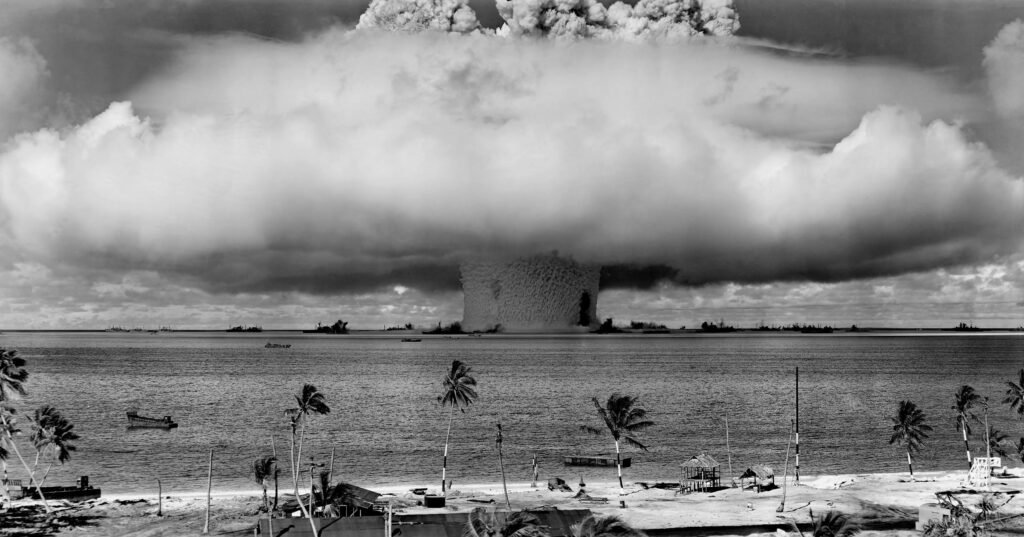
Russia’s invasion of Ukraine under President Vladimir Putin has brought global fears of a possible nuclear war. This geopolitical crisis’s escalation has also brought back serious discussions about the devastating consequences that could unfold if tensions escalate into nuclear warfare.
The threat of nuclear warfare currently seems distant to many Americans; however, experts warn that major U.S. cities are at higher risk of being targeted in such a scenario. It is unlikely Russia and the U.S. will escalate to nuclear warfare over Ukraine. However, if nuclear conflict erupted between the superpowers, it could be catastrophic for the entire planet.
Russia’s Nuclear Arsenal Poses an Unprecedented Threat

Russia is currently the world’s largest nuclear weapons stockpile owner, possessing approximately 4,380 warheads in its military arsenal as of early 2024. According to the Federation of American Scientists, an additional 1,200 retired warheads await dismantlement. This brings Russia’s total inventory to roughly 5,580 nuclear weapons. Combined with the United States, both the U.S. and Russia own 87% of the world’s total inventory of atomic weapons. Approximately 83% of those warheads are stockpiled, ready for military use.
This concentration of destructive power in two nations creates a precarious global situation. Russia has continued modernizing its nuclear forces despite economic sanctions and international pressure following the Ukraine invasion. President Putin has repeatedly made veiled nuclear threats throughout the conflict, lowering the threshold for potential use in an updated doctrine released in November 2024. These developments have created what President Biden described in October 2022 as the highest nuclear risk since the Cuban Missile Crisis of 1962.
Major U.S. Metropolitan Areas Would Be Primary Targets
In the event of a nuclear conflict involving Russia, several major American cities are at significant risk of being targeted. New York, Chicago, Houston, Los Angeles, San Francisco, and Washington, D.C. would likely be among the first locations struck by Russian intercontinental ballistic missiles.

These metropolitan areas house crucial government infrastructure, financial centers, and dense populations that make them strategic and devastating targets for the Russians. A map created using Federal Emergency Management Agency data and National Resources Defense Council information identifies these cities as probable first-strike locations. The map, originally compiled by journalist John Dodge in 2015 and reevaluated by The Independent in 2023, shows disturbing patterns of vulnerability across the nation.
Washington, D.C., a Primary Target
Washington, D.C., would most likely be targeted in the primary wave of attack, as it houses the core of the U.S. government and military command and control. The nation’s capital houses the Pentagon, White House, and countless defense-related facilities that Russia would target to weaken the the U.S. defense forces.
New York City would be a target as it is America’s financial center. It also holds the U.S.’s largest population concentration, with over 8 million residents in New York City. Los Angeles and San Francisco would face targeting as they house major populations and economic hubs on the West Coast. Chicago’s central location and status as America’s third-largest city make it another inevitable target. Houston’s concentration of energy infrastructure and petroleum refining capacity adds strategic value as a Russian target.
Following an initial attack on major cities, Russian missiles would begin targeting more populous areas and other critical infrastructure across America. Radioactive fallout from distant nuclear strikes could contaminate almost all of California and much of coastal New England. Fallout from strikes on military bases and densely populated areas could heavily damage communities across the entire state of Florida.
Nuclear Missile Fields Create Target Clusters in Western States
Colorado, Montana, North Dakota, and Wyoming would all be targeted by Russia because these states house America’s intercontinental ballistic missile arsenal. 400 Minuteman III missiles sit in underground silos stretching across these 5 states, including small portions of Nebraska. These missile fields at Malmstrom Air Force Base in Montana, Minot Air Force Base in North Dakota, and F.E. Warren Air Force Base in Wyoming form the land-based leg of America’s nuclear triad. Russia would target these silos to eliminate America’s ability to launch any retaliatory strikes.
Scientific modeling based on open source data from the Federal Emergency Management Administration (FEMA) and the National Resources Defense Council was used by Dodge to plot likely Russian nuclear targets. It also shows that a concentrated nuclear attack on these existing U.S. silo fields would annihilate all life in the surrounding regions. Minnesota, Iowa, and Kansas would be subjected to high levels of radioactive fallout despite being outside the direct strike zones. Acute radiation exposure alone could cause several million fatalities across the central United States. The fallout would contaminate fertile agricultural land for years, devastating America’s food production capacity. Western Texas, most of Nevada, and Michigan would be relatively clear of immediate fallout, though long-term nuclear winter effects would still impact these regions.

Nuclear Power Plants Represent Critical Vulnerabilities
Approximately 94 nuclear reactors operate at commercial power plants across 30 U.S. states, which are significant potential targets in a nuclear conflict. Some of the larger nuclear facilities experts identify as vulnerable include active plants in Alabama, Arizona, Maryland, New Jersey, Pennsylvania, and Tennessee.
The Vogtle Electric Generating Plant in Georgia is currently the largest nuclear facility in the United States, with four reactors producing 4,664 megawatts of capacity. Palo Verde in Arizona ranks second with three reactors generating 3,937 megawatts, while Browns Ferry in Alabama produces 3,775 megawatts from 3 reactors. These facilities contain radioactive materials and spent fuel that could create catastrophic secondary contamination if struck by nuclear weapons.
Russia might target nuclear power plants to maximize long-term environmental damage and render large American regions permanently uninhabitable. The concentration of nuclear plants in the eastern United States creates particular vulnerability, with multiple facilities in Pennsylvania, including Susquehanna, Peach Bottom, and Limerick plants. Illinois hosts several major nuclear installations, including Byron, Braidwood, and LaSalle stations, that could be targeted. Tennessee’s Sequoyah and Watts Bar plants, New Jersey’s Salem facility, and numerous reactors along the East Coast are all under threat if nuclear warfare breaks out.
The United Kingdom Faces Similar Devastation Risks

The United Kingdom has been a staunch supporter of Ukraine since the Russian invasion in 2022, providing military aid and imposing severe economic sanctions on Moscow. This is why it is most likely that the United Kingdom would be a potential target for a Russian nuclear attack if conflict erupts between the U.S. and Russia. According to a report by Newsweek, Russian officials threatened to bomb the United Kingdom at least 35 times between February and July 2022 alone.
Cold War-era maps discovered in Britain’s National Archives reveal which cities Russian forces planned to target during that era. Central London, Edinburgh, Teesside, Leicester, Manchester, Liverpool, Glasgow, Hull, York, Dover, Cambridge, Maidstone, Huddersfield, Wolverhampton, Coventry, and Sheffield all appeared on historical target lists. Experts believe these targets have changed little in the decades since, as they still house population-dense centers and important infrastructure.
London alone could expect up to 4-5 megaton bombs, according to declassified government documents from the Cold War period. Glasgow and Edinburgh were expected to endure two blasts each of similar magnitude, which were 333 times more powerful than the Hiroshima bomb.