I expected the evening to unfold effortlessly—the kind of first date where conversation flows so naturally that you forget to glance at the clock.
The restaurant glowed in soft candlelight, casting warm golden hues across polished tables and glassware. It felt intimate, almost suspended in time. My date and I slipped easily into conversation, talking about childhood memories, travel dreams, favorite books, and the strange coincidences that shape our lives. There were no awkward silences to fill, no forced laughter to disguise discomfort. Everything felt genuine.
Hours passed unnoticed. Plates were cleared, candles burned lower, and still the conversation carried on. When the check finally arrived, I reached for it confidently. It felt natural to take care of the bill, a small gesture that carried quiet significance. I handed over my card without hesitation.

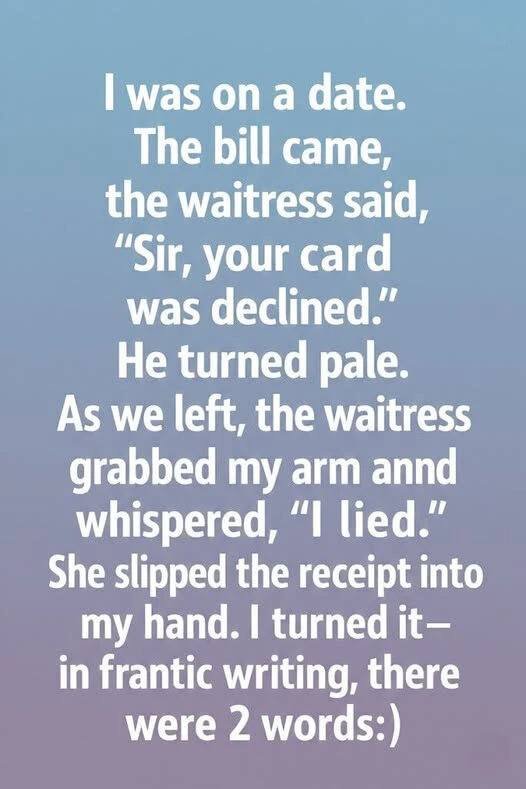
Moments later, the server returned. She leaned in gently and said, almost apologetically, that my card had been declined.
The words struck harder than I expected. It wasn’t about the money. It was about the sudden fracture in what had been a perfectly composed evening. The invisible crack in confidence. I offered another card quickly, trying to keep my voice steady. A few minutes passed. She returned again. Same result.
Embarrassment rushed in like heat rising to my face. I felt exposed, suddenly aware of every glance in the room—even though no one was looking. We decided to step outside to sort it out privately.
The cool night air wrapped around us, but it did little to calm the warmth burning in my cheeks. I fumbled through my wallet, checking apps, refreshing my banking screen, mentally replaying recent purchases. Everything looked fine. Yet the transaction had failed. I worried about what my date might think. How quickly a strong first impression could unravel. How fragile composure can be.
Then the restaurant door opened.
The server stepped outside and called my name softly.
She approached, her expression calm and reassuring. She gently touched my arm and whispered, “I lied.”
Before I could respond, she handed me a folded receipt and walked back inside.

Confused, I unfolded the paper slowly.
The bill was marked paid.
No signature from me. No explanation. Just confirmation that someone had covered the entire cost.
In that moment, the truth settled in gently. The declined-card scenario had been staged. The server had created a private explanation so that whoever paid could remain anonymous—and so that my dignity could remain intact.
Relief washed over me first. Then humility followed closely behind.
I showed my date the receipt. The tension dissolved instantly, replaced with quiet awe. We didn’t speculate loudly about who it might have been. We didn’t rush back inside to search the room for a benefactor. Instead, we walked.
Side by side beneath streetlights, we talked about how rare it is to witness kindness that asks for nothing in return. How powerful it is when generosity arrives softly, without applause. How sometimes the smallest gestures—barely noticeable to others—leave the deepest imprint on a person’s heart.
The next day, I returned to the restaurant.
I thanked the staff sincerely and quietly repaid the amount. They smiled, but offered no clues. Whoever had paid wanted it that way. Anonymous. Complete.
But something had shifted in me.
Not long after, I stood in line at a grocery store when I overheard a familiar sentence at the register ahead of me: “I’m sorry, your card has been declined.”
The shopper’s shoulders stiffened slightly—the same way mine had. That same flash of embarrassment crossed their face.
I stepped forward and paid the total without ceremony. I leaned toward the cashier and asked gently that it not be announced. No spotlight. No gratitude required.

The shopper turned slightly, confused at first, then relieved. I simply nodded and stepped away.
That folded receipt from the restaurant now rests inside a book on my shelf. It’s not there as proof of generosity. It’s there as a reminder.
A reminder that dignity matters.
That grace can be given in whispers.
That sometimes the most powerful kindness is the kind no one sees.
One small, discreet act turned a moment of embarrassment into something far greater—a lesson in humility, compassion, and quiet humanity.
And ever since that evening, I’ve learned this: when kindness is offered softly, it echoes the loudest.