Anyone who has ever tried to cram a week’s worth of outfits into a tiny carry-on knows the unique dread of the airport security line. As you inch closer to the front, you start to sweat the small stuff: Did I take my laptop out? Is my toothpaste exactly 3.4 ounces? But while you were worrying about what was inside your luggage, the scanners were busy looking at what was “inside” your clothes.
It turns out that for a brief, controversial window in aviation history, airport security staff were seeing a whole lot more than just keys and coins. In fact, the sheer level of detail captured by early body scanners has resurfaced online, leaving a new generation of travelers absolutely stunned—and more than a little uncomfortable.
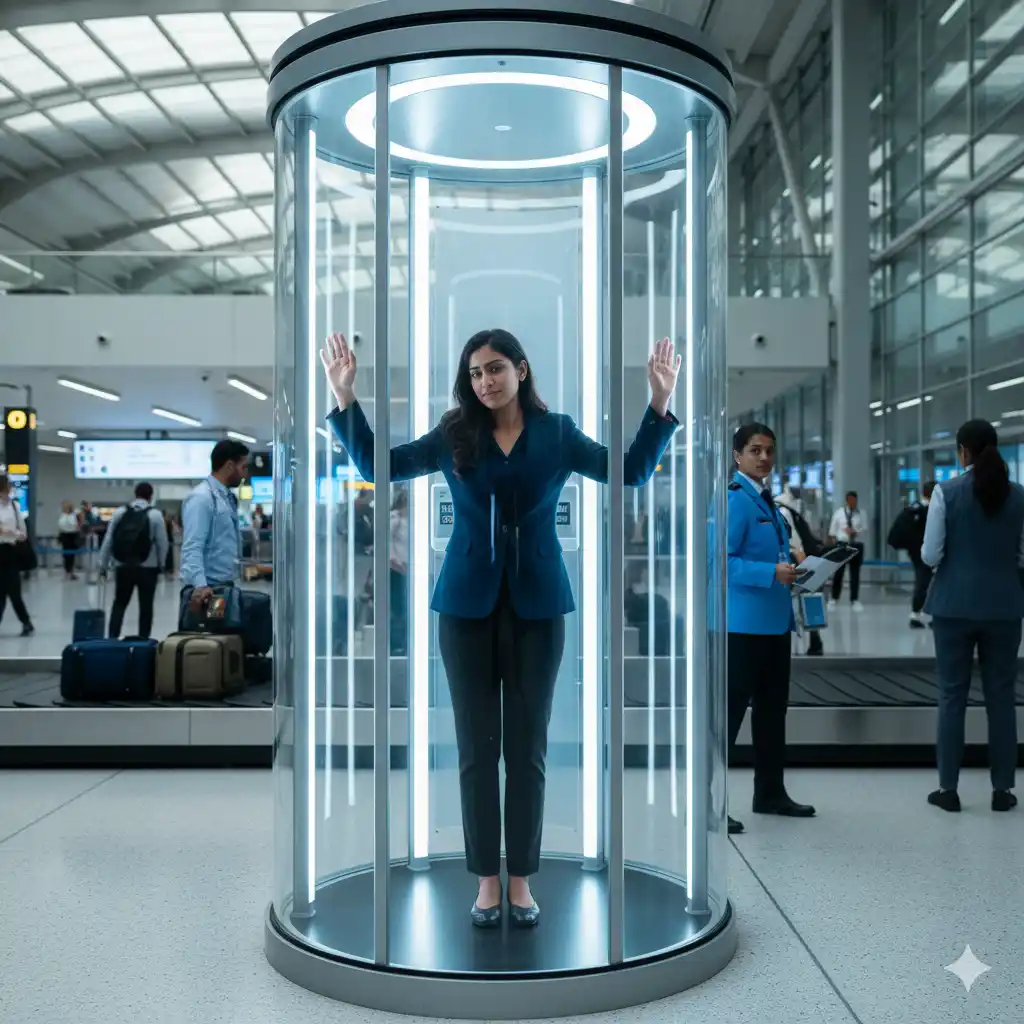
The “surrender” pose has become a standard part of modern travel, but the technology behind it has changed drastically.
The Era of the ‘Virtual Strip Search’
In the early 2010s, the Transportation Security Administration (TSA) rolled out the infamous Rapiscan X-ray machines across major U.S. airports. Introduced largely as a response to the 2009 Christmas Day “underwear bomber” attempt, these machines were meant to be the ultimate shield against hidden threats. However, they quickly earned a much more scandalous nickname: “Virtual Strip Searches.”
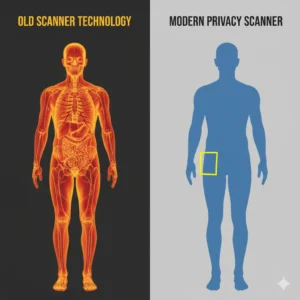
Unlike the scanners we use today, these backscatter X-ray machines produced high-resolution images of the passenger’s actual body. They didn’t just show a generic outline; they showed physical contours and anatomical details that many felt were a massive violation of personal privacy. Critics and travelers alike were horrified to realize that, essentially, a TSA agent in a back room was seeing a naked-adjacent version of every person who walked through the gates.
A Million-Dollar Privacy Crisis
The scale of this rollout was massive. Each unit came with a price tag of roughly $180,000. By the time the program hit its peak, 174 of these machines were operating in 30 different airports across the United States. Despite the high cost and the “security first” messaging from officials, the public backlash was impossible to ignore.
The internet, as it often does, reacted with a mix of horror and dark humor. When the images of what the scanners actually saw began to circulate, one user famously commented, “I’ll just drive everywhere, thanks.” Others were more pointed, calling the process “security theater” and joking that the experience felt more like an “OnlyFans” audition than a safety check.
Why the Scanners Finally Disappeared
By 2013, the pressure became too much. The TSA officially pulled the Rapiscan machines from airports nationwide. The tipping point wasn’t just the public outcry, but a failure of the technology to adapt to new privacy laws. Specifically, the machines were unable to support **Automated Target Recognition (ATR)** software.
ATR is the clever tech we use today that replaces your specific body image with a generic, cookie-cutter mannequin outline. If the machine detects something suspicious, it just places a yellow box on that generic shape. Because the old X-ray scanners couldn’t “hide” the passenger’s real body behind this digital mask, they had to go.
A Move Toward Millimeter Waves
Today, airports have switched to millimeter wave scanners. These are the systems you likely encounter now. They use non-ionizing electromagnetic radiation to “bounce” off the body, detecting objects without peering through your skin or showing your private anatomy.
As Shawna Malvini Redden, author of 101 Pat-Downs, explained to Reader’s Digest: “Early versions of the scanners came out without any privacy protections. Now, machines generate generic images instead of the passenger’s unique image.”
For many modern travelers, looking back at what was once standard practice is a major wake-up call. Social media users today are still reacting with disbelief, with one user admitting, “I thought X-ray meant you could only see bones.” It’s a stark reminder that in the world of security, the line between “safe” and “too close for comfort” is constantly being redrawn.
So, the next time you step into that glass tube and raise your hands, take a deep breath. It might be a little awkward, but at least the computer is only seeing a blue mannequin—not your weekend plans.