When my father died, grief did not arrive as a single overwhelming moment. It settled quietly into the corners of my life, filling the spaces where his presence had once been constant.
It lived in the silence after my phone stopped ringing, in the empty chair across the table, in the instinct to reach for him before remembering there was no one left to call. By the time the will was read, I felt hollow rather than shocked. Everything unfolded exactly as expected.
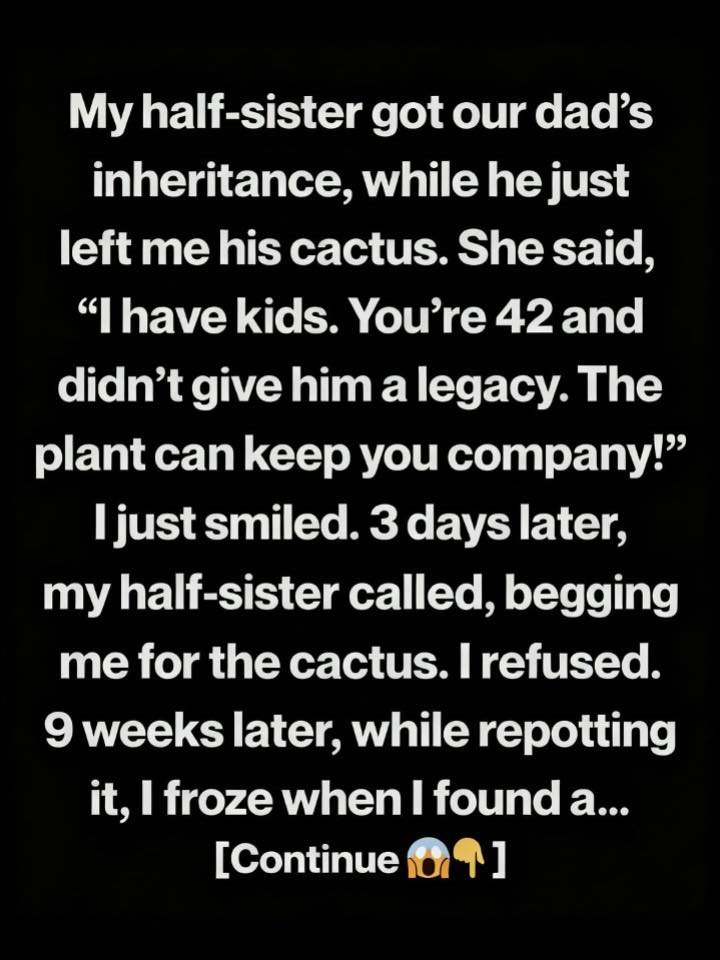
My half-sister received the house, the accounts, the items that gave shape and value to a lifetime. Papers were signed, numbers were read aloud, and certainty filled the room. Then the lawyer paused, looked up, and spoke my name. What followed was a single sentence that seemed almost misplaced among the formalities. I was left my father’s cactus.
It was the same cactus that had sat by his window for decades, leaning slightly toward the light, surviving moves, winters, and long stretches of neglect. My half-sister laughed, not cruelly, but without hesitation. She spoke of responsibility, of children, of practicality.
She said I was grown, independent, capable. A symbol, she suggested, should be enough for me. I didn’t argue. I didn’t explain how often I had seen my father standing beside that plant, his fingers resting in the soil as if grounding himself. I simply accepted the pot and carried it home with a care that surprised even me.
That night, I placed it at the center of my kitchen table and sat across from it, studying something that looked entirely ordinary. Yet I understood then that it was the one thing he had kept close every single day, the one thing he had never replaced or given away.
My father had never been skilled at expressing emotion directly. He communicated through routines, through quiet consistency, through objects that endured. In the days that followed, the meaning of the cactus began to unfold. He had once told me it reminded him of resilience, of surviving with little attention and growing despite long dry spells.
Three days later, my half-sister called again, her voice uncertain. She asked if I would consider giving her the cactus, saying it mattered more than she had realized. I declined gently. It was not about fairness or resentment. It was about holding on to the only thing that felt untouched by comparison or conflict, something chosen with intention rather than obligation.
Weeks passed, and caring for the cactus became part of my routine. One afternoon, while repotting it, I noticed something lodged near the roots. Buried beneath the soil was a small sealed envelope, worn with time. Inside was a note in my father’s handwriting. He wrote about his imperfections, his regrets, and his pride in the life I had built quietly and honestly.
He explained that the cactus was never meant to be just a plant, but a reminder that worth is not measured by lists or appearances. In that moment, his silence finally made sense. Today, the cactus still sits by my window, growing steadily, reminding me that the most meaningful inheritances are often the smallest ones, chosen not for value, but for understanding.